



























Sustainable Livelihoods

2026 Report

Download PDF (opens in a new tab)

Vision

Imagine...every person has a sustainable livelihood and contributes to their community. This is the vision that guides Momentum's work.

Momentum offers a range of skills training, local economy development, and financial empowerment programs for individuals with diverse backgrounds and experience. Momentum uses the Stages of Transition as a measurement tool to capture how participants' livelihoods are developing across its programs over time.

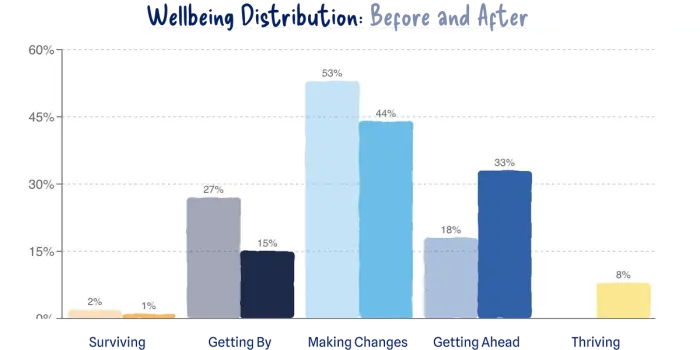
Data is collected with participants at the start and end of their programs, as well as the two years following their program. Even though the stages are presented in a linear direction, the framework recognizes the dynamics and challenges of everyday life which can cause individuals to move back and forth through the Stages of Transition.

A sustainable livelihood is defined as "the capabilities, assets, and activities required for a means of living. A livelihood is sustainable when it can cope with and recover from stresses and shocks, maintain or enhance its capabilities and assets both now and in the future."1

Chapter 1: Sustainable Livelihoods Framework

The Stages of Transition identifies key patterns of progress towards a sustainable livelihood. The stages include: Surviving, Getting By, Making Changes, Getting Ahead, and Thriving. As individuals build their assets, they increase their resilience and ability to thrive.

Momentum offers a range of skills training, local economy development, and financial empowerment programs for individuals with diverse backgrounds and experience. Momentum uses the Stages of Transition as a measurement tool to capture how participants' livelihoods are developing across its programs over time.

Data is collected with participants at the start and end of their programs, as well as the two years following their program. Even though the stages are presented in a linear direction, the framework recognizes the dynamics and challenges of everyday life which can cause individuals to move back and forth through the Stages of Transition.

Stages of Transition

  • Surviving

    Cycle of crisis, primary focus is meeting basic needs

  • Getting By

    Still requires support, but is establishing basic knowledge or resources

  • Making Changes

    Still requires support, but is establishing basic knowledge or resources

  • Getting Ahead

    Still requires support, but is establishing basic knowledge or resources

  • Thriving

    Still requires support, but is establishing basic knowledge or resources

The five asset areas highlight individuals' existing capabilities in pursuing a sustainable livelihood. At Momentum, participants learn about assets, assess their assets, and use the asset areas to set short-term and long-term goals. The five asset areas include: Connections, Sense of Self, Basic Needs & Services, Skills & Knowledge, and Finances.

  • Finances

    An individual's money from work, family and government supports, along with a bank account, savings and access to credit."

  • Connections

    The relationships and networks in an individual’s personal and professional life.

  • Sense of Self

    An individual’s values, beliefs and personal qualities (such as confidence, motivation, creativity, and hope for future).

  • Basic Needs

    The physical things that an individual needs (such as food, clothing, shelter and transportation) as well as access to services in the community (such as recreation and childcare)

  • Skills and Knowledge

    The skills, knowledge, and abilities that help an individual live, work, and participate in their community

Momentum Participants

  • Financials

    Momentum has helped create a healthy habit of saving and what I should spend my money on. I am very grateful! [The facilitator] has been a compassionate tutor who made me feel like I could learn the confusing world of finances.

    Youth Fair Gains participant
  • Connections

    When I came here, I was alone. Now, I do have these friends and they are from my field, and they are also working. If I got stuck anywhere, definitely they will help me.

    Tech Plus participant
  • Sense of Self

    While basic needs and services, skills and knowledge, finances, and connections all play equal and important roles, sense of self reminded me the qualities I possess to aid in building and maintain a successful entrepreneurship.

    Youth Fair Gains participant
  • Basic Needs & Services

    When I came here, I was alone. Now, I do have these friends and they are from my field, and they are also working. If I got stuck anywhere, definitely they will help me.

    Tech Plus participant
  • Skills & Knowledge

    Momentum has helped create a healthy habit of saving and what I should spend my money on. I am very grateful! [The facilitator] has been a compassionate tutor who made me feel like I could learn the confusing world of finances.

    Youth Fair Gains participant

Vulnerability Context

What holds people back?

  • Systems

    The formal and informal biases and discrimination that reduce people’s opportunities

    Eg. Racism, sexism

  • Cycles

    Patterns connected to the stages of people’s lives

    Eg. Reproductive choice, Family roles, relationships and seasonality

  • Trends

    Broader social, economic and political forces that can impact people’s security

    Eg. Globalization, increasing low-paid/part-time work

  • Shocks

    Sudden catastrophic events or experiences

    Eg. Accidents, job loss, divorce/separation, natural disasters, health crisis

Chapter 2: Building Sustainable Livelihoods

Momentum examined the ways that participants are building sustainable livelihoods over the long term, by following them for two years after they started a program at Momentum.

The evaluation results found growth in participants’ skills and knowledge, self-confidence, money management skills, and income, as well as improved debt management, living situation (housing), and employment. An equity analysis of the different communities and groups that make up Momentum participants found a wide diversity of people experienced growth and success across programs and learning approaches. Overall, evaluation results demonstrate success despite challenges with increased cost of living, stagnant wages, and a housing crisis, among other external factors.

66%

Of participants moved closer to sustainable livelihood

Over 2 Years

89%

increased in income (average of $27,250) for those that grew their income

69%

Increased their income

2018– 2025

1360 participants were asked about the ways they have built a sustainable livelihood in partnership with Momentum, and how they have built their assets over the long-term.

80%

increased their connections

Financial Empowerment

93% Applied their skills and knowledge to build assets and income

75%

passed their certification exams

increase from 21% to 41% in participants with emergency savings

Tech Training Participants

75% Passed their certification exams

75%

Trades Training Participants passed their certification exams

Local Economy
Development Participants

88% Increased their skills and knowledge

87%

increased their understanding of money management

90%

Were hopeful about the future

75%

of participants living situation now meets most or all of their needs

Across All
Departments

88% Increased their skills and knowledge

5%

More participants were able to pay down or pay off debt in full each month

decrease from 30% to 15% in participants receiving income support

2026 Sustainable Livelihoods Long-Term Evaluation Report: Results Summary

The evaluation results found growth in participants’ skills and knowledge, self-confidence, money management skills, and income, as well as improved debt management, living situation (housing), and employment. An equity analysis of the different communities and groups that make up Momentum participants found a wide diversity of people experienced growth and success across programs and learning approaches. Overall, evaluation results demonstrate success despite challenges with increased cost of living, stagnant wages, and a housing crisis, among other external factors.

Momentum Participants

34%

Had a high-school education or less

34%

Had a high-school education or less

34%

Had a high-school education or less

34%

Had a high-school education or less

34%

Had a high-school education or less

Chapter 3: How we do our work

Momentum's Theory of Change is to reduce poverty by increasing the income and assets of people living on low incomes in Calgary.

Momentum works with participants in our Local Economy Development, Financial Empowerment, and Skills Training programs, along with partners in our community to create a thriving local economy for all. By working at the individual and systems levels, Momentum makes impactful contributions to reducing poverty and building sustainable livelihoods. To evaluate our efforts, the Sustainable Livelihoods framework is used to demonstrate Momentum's outcomes and learn how participants are transitioning towards a sustainable livelihood.

Theory of Change

Infographic depicting a Theory of Change: People + Families (Increase income and assets of people living on lower incomes in Calgary. Financial Empowerment, Skills Training, Entrepreneurship), Communities, Workplaces + Society (Increase economic inclusion. Policy Change, Systems Influence, Capacity Building). Reduce poverty and build a more equitable Calgary.

Reduce poverty and build a more equitable Calgary

Momentum By the Numbers

Since 1991, Momentum has made a profound impact on individuals and families living on low incomes in Calgary. More than 60,000 people have participated in Momentum's programs, with nearly $9.2 million invested in the local economy through 3,200+ micro loans and over $5.7 million saved through the matched savings program. Momentum has trained over 1,700 individuals for careers in the trades, helped more than 187 families purchase homes, and supported the opening of nearly 7,500 RESPs. Through partnerships and community networks, over 600 organizations have been equipped to deliver financial literacy workshops — collectively reaching more than 44,000 individuals across the region.

  • 60K+

    People have participated in Momentum’s programs

  • 9.2M

    micro loans have been invested in the local economy through 3,200+ micro loans

  • 5.7M+

    Matched savings, saved by more than 3,300 participants in Momentum’s matched-savings program

  • 1700+

    individuals trained for careers in the trades

  • 187+

    homes have been purchased through the Owen Hart Home Ownership program and Financial Empowerment programs

Chapter 4: Mervis's Journey

Mervis’s Story

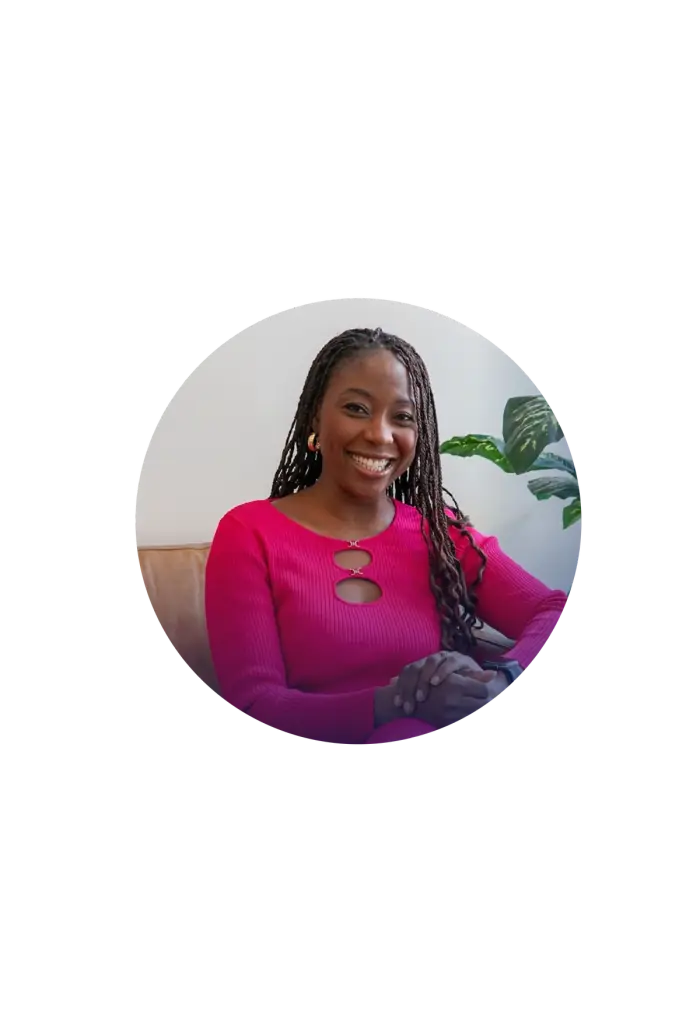
Mervis left Nigeria in 2022 seeking safety, stability, and opportunity for herself and her two daughters. Her husband stayed behind to keep working, planning to join them once she was settled. Despite her education and experience, she faced repeated job rejections, and her savings quickly dwindled

I tried to stretch every dollar and reset my children’s expectations of what basic needs were. I remember feeling disappointed when I had to tell the girls no, over and over again, while also dealing with feelings of rejection myself.

As her finances worsened, Mervis turned to the food bank and was researching programs when she found Momentum’s Women in Tech program. With her credit cards maxed out and stress mounting, Momentum provided additional financial assistance so she could focus on her training. She gained technical and soft skills, plus valuable Canadian work experience through an internship.

I was feeling desperate. At this point, my savings were gone. It didn’t feel like we had options. I was thinking maybe we had to sell our car just to get back to Nigeria.

But progress isn’t always linear. Despite her strong performance, budget constraints meant the company couldn’t offer her a permanent role, and she found herself back in the job market

Hope began to arise again in my heart. I had a good manager and got feedback that she wanted to keep me on the team. Finally, I could see a stable income in our future and thought, ‘thank God, we can start paying our debt and my husband will be able to join us!

Then a temporary position opened a new door, which led to her employer offering her a full-time managerial role. Around the same time, she completed Momentum’s Matched Savings program, gaining the financial knowledge to manage her new income. With stability finally in reach, her husband was able to join her in Canada after two years apart, and the family welcomed a new baby the following spring.

The immigrant experience is hard and can be isolating. People just need hope and support. Momentum ignited a hope in me. I’m no longer worried about keeping the lights on, and instead of working to survive, I am self-sufficient and can plan for the future.

Her mother is visiting from Nigeria to help with the baby, and thanks to careful budgeting, Mervis was able to buy her much needed hearing aids.

A smiling woman wearing pink